Why Foreign Brands Were Historically Locked Into a Local Agent
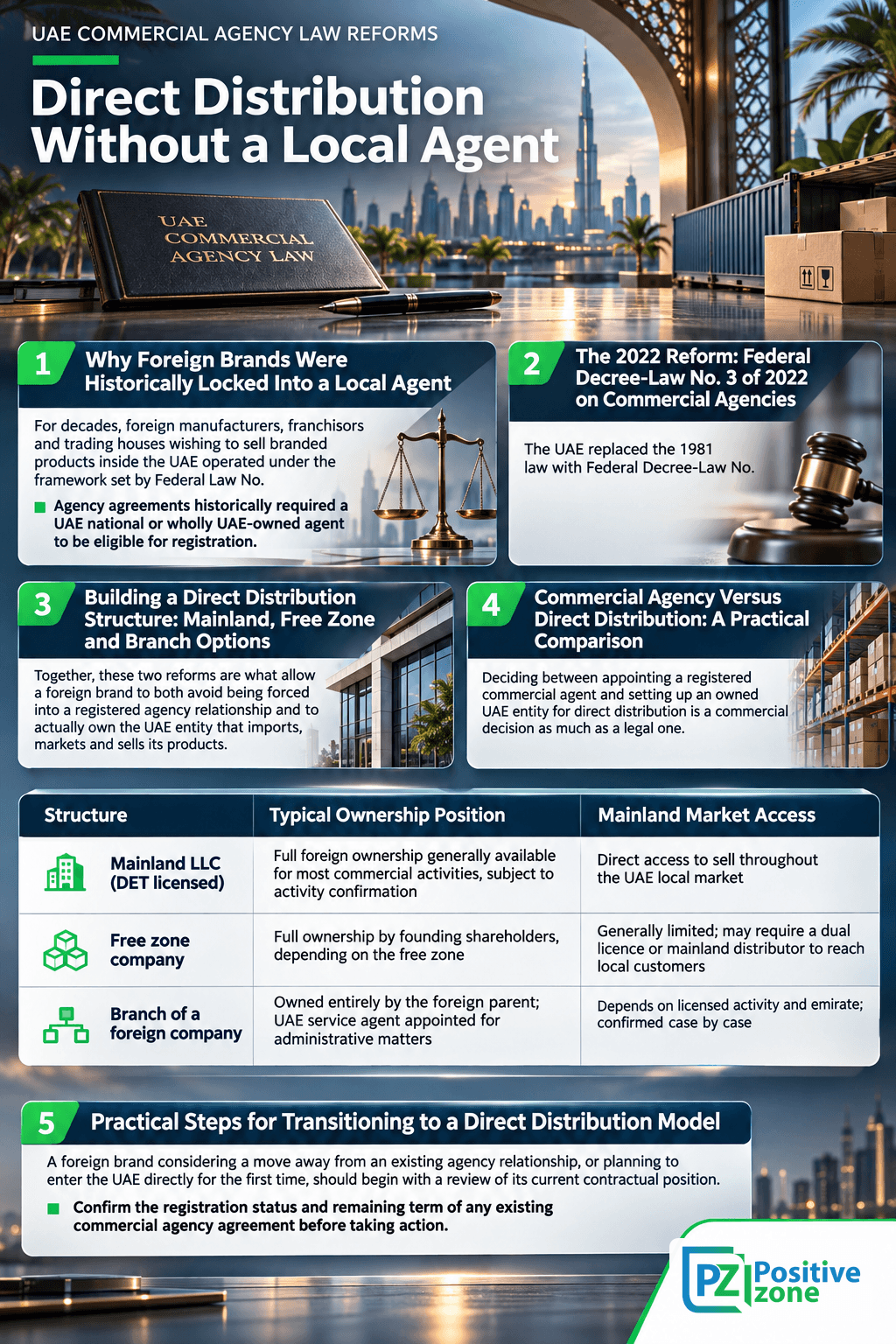
For decades, foreign manufacturers, franchisors and trading houses wishing to sell branded products inside the UAE operated under the framework set by Federal Law No. 18 of 1981 Concerning the Organisation of Commercial Agencies. Under that original law, a foreign principal who wished to appoint a commercial agent was required to use an agent who was either a UAE national or a company wholly owned by UAE nationals, and the resulting agency agreement had to be registered with the UAE Ministry of Economy's Commercial Agencies Register before it carried formal legal recognition.
That registration was not a mere formality. A registered agent obtained strong statutory protections, including the practical ability to block the import of competing or parallel-imported goods through UAE customs, exclusivity across the whole UAE or an agreed territory, and in many cases a right to compensation if the principal terminated the relationship, declined to renew it, or tried to sell directly, even where the agent was not clearly at fault. For an international brand, this meant that once a commercial agency agreement was registered, disengaging from that agent to pursue a different distribution strategy, including setting up an owned UAE entity, could be commercially and legally difficult.
This structure made sense when foreign companies were broadly restricted from owning UAE mainland companies outright and needed a UAE-based partner to operate locally. It became a significant constraint once the UAE began liberalising foreign ownership rules, because brands increasingly wanted the option of controlling their own UAE pricing, inventory, after-sales service and customer relationship rather than delegating all of this to an intermediary with strong statutory leverage.
- Agency agreements historically required a UAE national or wholly UAE-owned agent to be eligible for registration.
- A registered agreement gave the agent exclusivity and the practical ability to restrict parallel imports through customs.
- Terminating or not renewing a registered agency could expose the principal to a compensation claim, independent of agent performance.
- These protections made it difficult for a foreign brand to later switch to direct distribution without negotiation or dispute.
The 2022 Reform: Federal Decree-Law No. 3 of 2022 on Commercial Agencies
The UAE replaced the 1981 law with Federal Decree-Law No. 3 of 2022 Regulating Commercial Agencies, which recalibrated the balance between agent protection and principal flexibility. The most significant structural change is that registration of a commercial agency agreement with the Ministry of Economy is no longer a precondition for the agreement's legal validity. Agreements can still be registered, and registration continues to carry defined statutory consequences, but a principal and agent are now also free to operate under an unregistered commercial relationship governed primarily by ordinary contract law rather than the special agency protections.
This distinction matters a great deal in practice. A registered agency agreement under the new law continues to benefit from defined protections, but these are now generally tied to a specific agreed term rather than the open-ended arrangements that were common before, and the parties know in advance how renewal, non-renewal and expiry will be treated. An unregistered arrangement, by contrast, is treated as a standard distribution or supply contract. The foreign principal retains much greater freedom to appoint more than one distributor, to review pricing and territory terms periodically, or to move toward direct distribution through its own UAE entity, since the arrangement does not carry the same customs-level exclusivity lock that a registered agency previously guaranteed.
The reform also introduced a dedicated Commercial Agency Committee at the Ministry of Economy to review certain categories of agency disputes before they escalate to the courts, which is intended to give both foreign principals and UAE-based agents a faster administrative route to resolve disagreements over registration, renewal or compensation. This sits alongside the UAE's ordinary civil and commercial court system, which continues to hear disputes that fall outside the committee's administrative remit.
Taken together, the effect of Federal Decree-Law No. 3 of 2022 is not that commercial agency has been abolished. Many brands, particularly in categories where a strong on-the-ground distribution partner adds real value, will continue to choose a registered agent. What has changed is that registration and the associated exclusivity are now a deliberate choice rather than an unavoidable gateway to doing business in the UAE, which is what makes direct distribution a realistic option for brands that prefer to control their own UAE presence.
Building a Direct Distribution Structure: Mainland, Free Zone and Branch Options
The commercial agency reform works alongside a separate but closely related liberalisation: the amendment of the UAE Commercial Companies Law, which removed the former requirement for an Emirati national shareholder to hold the majority of shares in most UAE mainland commercial and industrial activities. Together, these two reforms are what allow a foreign brand to both avoid being forced into a registered agency relationship and to actually own the UAE entity that imports, markets and sells its products.
Choosing the right entity for direct distribution depends on where the brand's actual customers are. A business that intends to sell physically into the Dubai or wider UAE local market, rather than purely exporting or selling to other free zone businesses, generally needs a mainland presence. A UAE mainland LLC licensed through the relevant Department of Economy and Tourism in each emirate can generally import goods under its own name, hold its own customs code, open its own trade accounts with suppliers and sell directly to UAE retailers, distributors or end customers, subject to the activity classification approved on its licence.
Free zones remain an efficient option for brands that are using the UAE primarily as a regional hub for export, re-export or business-to-business trading with other free zone or international entities, since free zone companies benefit from streamlined incorporation and, depending on the free zone and licensed activity, full ownership by the founding shareholders. However, a free zone company's ability to sell directly into the UAE mainland market is generally more limited than a mainland entity's, and many free zones and mainland authorities now offer a dual licence route that extends a free zone company's activity into the mainland for specific commercial purposes. This route needs to be confirmed against the specific free zone and the activity concerned rather than assumed to apply automatically.
A third route, less commonly used by brand owners but relevant for established international groups, is registering a branch of the foreign parent company in the UAE. A branch allows the foreign company to operate under its own corporate name without creating a separate UAE legal entity, though it typically requires a locally appointed service agent for administrative purposes and is subject to its own licensing conditions that should be confirmed with the relevant authority before this route is selected.
| Structure | Typical Ownership Position | Mainland Market Access | Best Suited To |
|---|---|---|---|
| Mainland LLC (DET licensed) | Full foreign ownership generally available for most commercial activities, subject to activity confirmation | Direct access to sell throughout the UAE local market | Brands selling directly to UAE retailers, distributors or end consumers |
| Free zone company | Full ownership by founding shareholders, depending on the free zone | Generally limited; may require a dual licence or mainland distributor to reach local customers | Export, re-export, regional trading hubs and business-to-business supply |
| Branch of a foreign company | Owned entirely by the foreign parent; UAE service agent appointed for administrative matters | Depends on licensed activity and emirate; confirmed case by case | Established groups wanting to operate under their existing corporate name |
Commercial Agency Versus Direct Distribution: A Practical Comparison
Deciding between appointing a registered commercial agent and setting up an owned UAE entity for direct distribution is a commercial decision as much as a legal one. A registered agent brings local market knowledge, existing retail relationships and an established sales network, which can be valuable for a brand entering the UAE for the first time. Direct distribution gives the brand control over pricing, brand positioning, customer data and profit margin, but it also means the brand carries the full cost and operational responsibility of building its own UAE presence, including warehousing, staffing, import compliance and after-sales service.
The comparison below sets out the factors that we generally discuss with foreign principals weighing up the two models. It is intended as a planning reference, not as a substitute for a review of the specific agreement or activity involved.
| Factor | Registered Commercial Agency | Direct Distribution via Owned UAE Entity |
|---|---|---|
| Exclusivity | Agent typically holds territorial exclusivity and customs-level import protection for the agreed term | No automatic exclusivity; principal controls how many channels it uses |
| Termination flexibility | Ending the relationship before an agreed term may trigger a compensation discussion under the agency framework | Principal can restructure its own distribution strategy without agency-specific compensation exposure |
| Control over pricing and branding | Shared with, or largely delegated to, the agent | Retained directly by the brand through its own UAE entity |
| Local market knowledge | Agent generally brings established retail and distribution relationships | Must be built by the brand's own UAE team or through appointed non-exclusive distributors |
| Set-up requirement | No separate UAE entity required for the principal | Requires incorporation of a mainland LLC, free zone company or branch, plus licensing and operational set-up |
| Dispute route | Commercial Agency Committee and courts, depending on registration status | Ordinary commercial contract and company law routes |
Practical Steps for Transitioning to a Direct Distribution Model
A foreign brand considering a move away from an existing agency relationship, or planning to enter the UAE directly for the first time, should begin with a review of its current contractual position. If an existing agreement is registered with the Ministry of Economy, we recommend obtaining a clear picture of its registration status, remaining term and renewal provisions before taking any step that could be read as a unilateral termination or a breach of exclusivity. If no agency relationship currently exists, the brand has considerably more flexibility to design its UAE entry from the outset around a wholly owned entity.
Once the contractual position is understood, the practical work of establishing a UAE presence follows a broadly consistent sequence: selecting the appropriate jurisdiction and legal structure, securing the correct licensed activity for importing and distributing the specific product category, opening a corporate bank account to support trade finance and supplier payments, and registering for corporate tax and, where applicable, VAT, so that the entity is compliant from its first transaction.
Positive Zone supports foreign brands through each of these stages. Our Dubai Mainland LLC Formation and DET Licensing service helps founders select and apply for the correct commercial activity classification for direct import and distribution, while our Free Zone Company Setup service is relevant where export, re-export or a regional trading hub model is the better fit. Where a brand needs working capital accounts and supplier payment facilities, our Corporate Bank Account Opening and KYC Advisory service assists with preparing the documentation that banks require, without guaranteeing a particular bank's decision, since account approval always rests with the bank itself. Our Corporate Tax Registration and Filing Advisory and Accounting and Bookkeeping Services support the entity's ongoing compliance once trading begins, and our Legal and Business Consultation service can connect you with the appropriate review of any existing agency agreement before a transition decision is finalised.
For founders who also plan to relocate to the UAE to oversee their new distribution entity, our UAE Investor Golden Visa Processing service is a separate but complementary workstream worth discussing early, since residency planning and corporate structuring are often addressed together rather than sequentially.
- Confirm the registration status and remaining term of any existing commercial agency agreement before taking action.
- Select the licensing route, mainland, free zone or branch, that matches where your actual customers are located.
- Secure the correct licensed activity description for importing and distributing your specific product category.
- Open a corporate bank account and register for corporate tax before your first commercial transaction.
- Review after-sales service, warranty and consumer protection obligations that may continue to apply regardless of distribution model.
Managing the Risks: Existing Agreements, Termination and Compliance
The commercial agency reform is prospective in character, meaning it changes the framework for how new relationships are structured, but it does not automatically rewrite the terms of agreements that were already registered before the new law took effect. Agreements registered under the earlier framework may continue to carry the protections that applied at the time of registration, and transitional treatment of existing agreements should be confirmed through a specific legal review rather than assumed from the general reform.
Foreign principals sometimes assume that because registration is no longer compulsory, they can simply stop supplying a registered agent and move to direct distribution without consequence. This is a significant area of legal risk. Where a registered agency agreement remains in force, ending the supply relationship, appointing a competing distributor in the same territory, or beginning direct sales in competition with the agent can still expose the principal to a claim before the Commercial Agency Committee or the courts, depending on the specific terms and the agreement's registration status.
We therefore recommend that any brand currently supplying the UAE market through a registered agent obtain a dedicated legal opinion on its specific agreement before announcing or implementing a change in distribution strategy. This is equally important for brands that are agency-free today but are negotiating a new distribution contract, since the commercial terms agreed now, including whether the parties choose to register the agreement, will determine how much flexibility the brand retains in future.
Finally, moving to direct distribution does not remove a brand's other UAE compliance obligations. A direct distribution entity remains responsible for its own import documentation, product conformity and labelling requirements, consumer protection obligations, corporate tax registration and filing, and, where applicable, VAT accounting. These obligations sit alongside, rather than in place of, the commercial agency considerations discussed above.
Article FAQs3 questions
Questions and answers
Not in every case. Federal Decree-Law No. 3 of 2022 removed registration as a precondition for an agency agreement's validity, and the parallel liberalisation of UAE company ownership rules means many brands can now establish their own UAE mainland or free zone entity instead of appointing a registered local agent. Whether a particular activity still benefits from, or in limited cases requires, a local partner should be confirmed against the specific sector and licensing authority.