What the DET E-Trader Licence Actually Covers
The E-Trader licence is an initiative introduced by Dubai's Department of Economy and Tourism (DET), formerly the Department of Economic Development (DED), to formalise home-based and social-media-driven commercial activity. It was designed for individuals who sell goods or services through platforms such as Instagram, WhatsApp Business or an e-commerce storefront without operating from a conventional office, shop or warehouse.
Historically, eligibility for the E-Trader licence has been linked to UAE nationals and GCC nationals, with later expansion to UAE residents in specific categories. Because eligibility criteria, permitted activities and renewal conditions are set and periodically revised by DET, we do not treat any previously published eligibility threshold as a fixed 2026 rule. Foreign entrepreneurs who are not UAE or GCC nationals should treat the E-Trader licence as a structure to discuss with us and verify directly with DET, rather than assume automatic qualification.
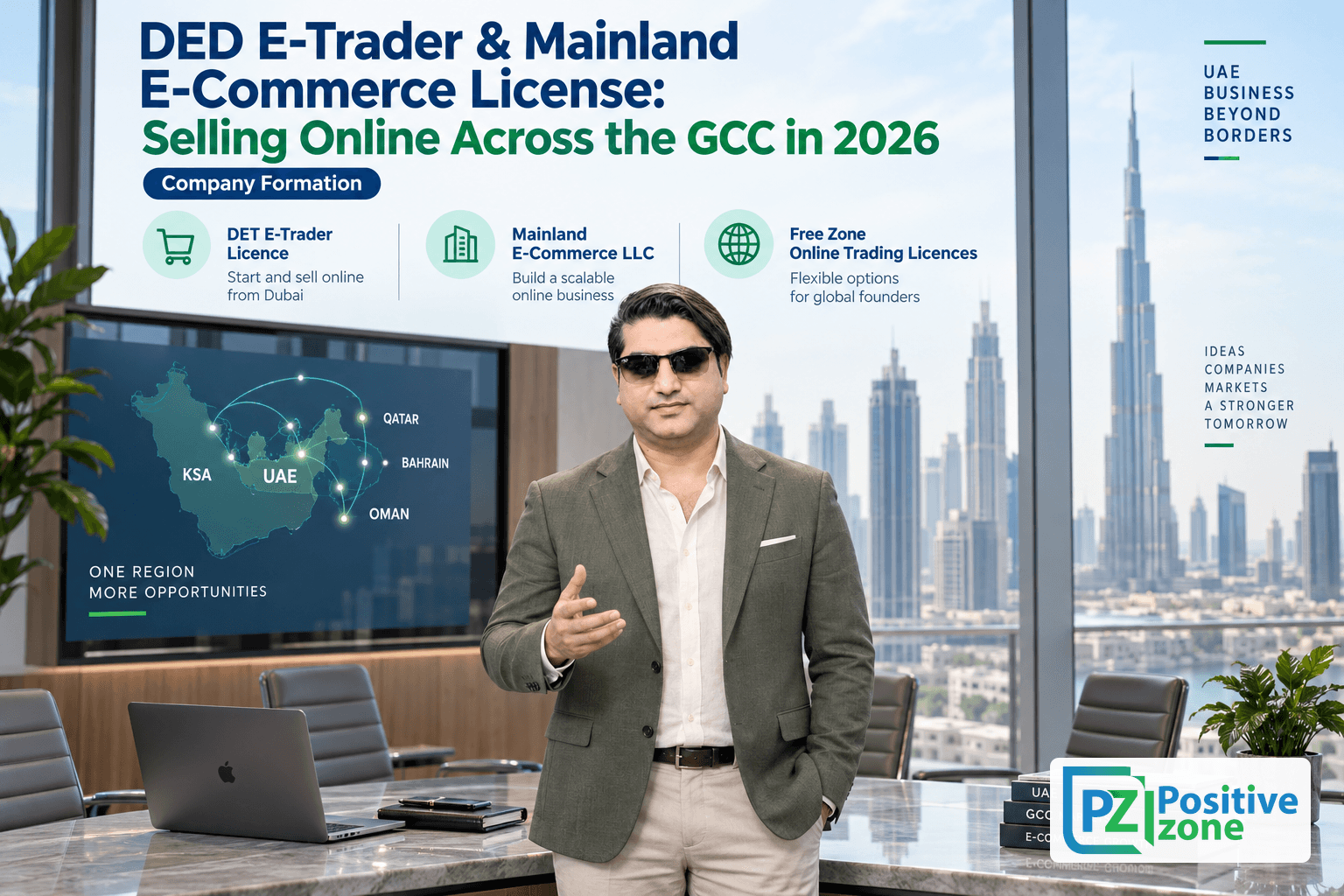
For most foreign investors, the more relevant and reliably available route into UAE-based online selling is a Mainland LLC carrying a recognised e-commerce activity code, or a free zone trading licence configured for online retail. Both of these are structures we actively support, and both allow 100% foreign ownership under the UAE's current commercial companies framework for the vast majority of trading activities.
- E-Trader licences are generally associated with individual, home-based or social-media selling rather than large-scale import, warehousing or wholesale distribution.
- The licence has traditionally excluded activities requiring a physical retail premises, significant imported stock holding, or regulated goods categories.
- Eligibility rules, permitted nationalities and renewal procedures are determined by DET and should be confirmed directly before a foreign founder commits to this route.
- Many international sellers find that a Mainland LLC or free zone e-commerce licence better matches their operational needs, especially where multi-platform selling, imported inventory or GCC-wide delivery is involved.
Mainland E-Commerce LLC: The Broadest Route for Foreign-Owned Online Trading
A Dubai Mainland company registered under DET with an appropriate e-commerce or online trading activity code is, in practical terms, the most flexible licensing structure available to a foreign-owned online business operating from the UAE. Mainland companies can trade with customers and businesses across all seven Emirates without the free zone restrictions that historically limited direct mainland market access, and they can generally hold import codes, work with local distributors, and contract with payment gateways and logistics partners operating UAE-wide.
The UAE's Commercial Companies Law reforms have opened the great majority of commercial and trading activities, including e-commerce, to 100% foreign ownership on the mainland, removing the need for a local Emirati partner holding equity in the company for most activity categories. Some strategic or security-related activities remain subject to specific ownership rules set by the relevant authority, so we confirm the applicable ownership position for your chosen activity code before filing.
A mainland e-commerce licence typically requires a registered business address — this can be a flexi-desk or serviced office arrangement for many activity codes, rather than a full commercial unit, which keeps initial overheads proportionate to an online-first business model. The DET activity list includes specific codes for 'e-commerce' as a standalone trading activity, as well as codes that permit online retailing of defined product categories (electronics, apparel, cosmetics, food products and others), and the correct code selection materially affects what you may legally sell and advertise.
- Mainland licensing allows trading across all Emirates without needing a separate mainland distributor arrangement in most cases.
- 100% foreign ownership applies to the large majority of e-commerce and trading activity codes under current Commercial Companies Law provisions.
- A flexi-desk or shared office solution is often sufficient for the registered address requirement, depending on the specific activity and DET's current premises rules.
- Correct ISIC/DET activity code selection determines your permitted product categories, import eligibility and advertising scope — this should be mapped to your actual business model before application.
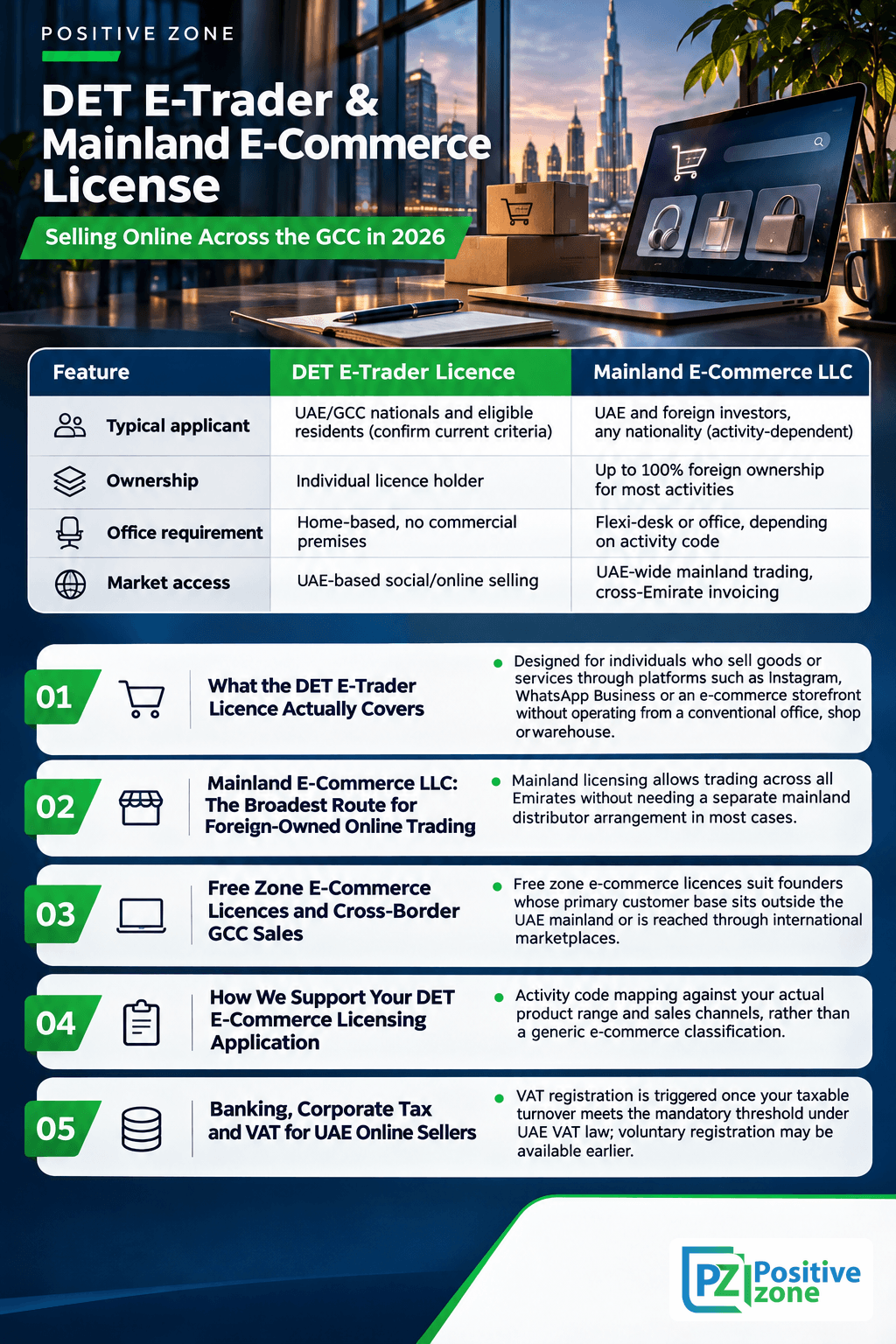
| Feature | DET E-Trader Licence | Mainland E-Commerce LLC | Free Zone E-Commerce Licence |
|---|---|---|---|
| Typical applicant | UAE/GCC nationals and eligible residents (confirm current criteria) | UAE and foreign investors, any nationality (activity-dependent) | UAE and foreign investors, any nationality |
| Ownership | Individual licence holder | Up to 100% foreign ownership for most activities | 100% foreign ownership |
| Office requirement | Home-based, no commercial premises | Flexi-desk or office, depending on activity code | Flexi-desk/virtual office included in most free zone packages |
| Market access | UAE-based social/online selling | UAE-wide mainland trading, cross-Emirate invoicing | Free zone and international; mainland sales often need a distributor or dual licence |
| Best suited to | Individual home-based sellers | Scaling online retailers, importers, multi-platform sellers | Foreign founders prioritising low setup overhead and international focus |
Free Zone E-Commerce Licences and Cross-Border GCC Sales
UAE free zones, including those we work with such as SHAMS, SPC, RAKEZ, Meydan, IFZA and AFZA, each publish e-commerce or online trading licence packages aimed at founders who want full foreign ownership, a straightforward registration process and a recognised business address without committing to a large mainland office. These licences are frequently chosen by founders selling internationally through marketplaces such as Amazon.ae, noon, or their own Shopify storefront, where the bulk of customers are reached digitally rather than through a UAE retail presence.
The limitation founders need to understand clearly is market access. A free zone company is, by definition, licensed within the jurisdiction of that free zone. Selling directly into the UAE mainland market from a free zone entity without a distributor, mainland branch or dual-licence arrangement can create compliance exposure. For founders whose customer base is substantially outside the UAE mainland — other GCC states, Europe, or international e-commerce platforms with fulfilment outside the UAE — a free zone structure is often entirely appropriate. For founders planning significant direct-to-consumer sales inside Dubai, Abu Dhabi or the other Emirates, we typically recommend evaluating a mainland structure instead, or a dual-licensing approach combining both.
Selling across the wider GCC (Saudi Arabia, Qatar, Bahrain, Oman, Kuwait) from a UAE base introduces a further layer of consideration: each GCC state maintains its own commercial registration, customs and VAT framework. A UAE free zone or mainland licence does not, by itself, grant automatic trading rights inside another GCC jurisdiction. Cross-border GCC fulfilment is usually structured through a combination of UAE-based warehousing, GCC customs clearance arrangements and, where volumes justify it, local registration or a distribution partner in the destination market. We help founders plan this sequencing rather than assume one UAE licence covers the entire GCC.
- Free zone e-commerce licences suit founders whose primary customer base sits outside the UAE mainland or is reached through international marketplaces.
- Selling directly to UAE mainland consumers from a free zone entity generally requires a distributor agreement, mainland branch or dual licence — confirm this before building a mainland-facing sales funnel.
- Each GCC state has its own commercial registration and customs regime; a single UAE licence does not automatically authorise trading inside Saudi Arabia, Qatar or the other Gulf states.
- Warehousing and logistics partners should be selected with your actual target markets in mind, since fulfilment location affects both customs treatment and delivery timelines across the GCC.
How We Support Your DET E-Commerce Licensing Application
Our Senior Advisory Team works with founders through each stage of Dubai Mainland e-commerce licensing, from initial activity classification through to final DET approval. Because the correct activity code governs what you can legally sell, advertise and import, we begin by reviewing your actual product range, sourcing model and sales channels before recommending a licence structure — rather than defaulting to a generic 'e-commerce' code that may not match your intended operations.
Where a trade name reservation, initial approval, Memorandum of Association and external approvals (for regulated product categories such as cosmetics, food, electronics or health-related items) are required, we coordinate the documentation and liaise with DET and any relevant regulatory authority on your behalf. We also advise on the office or flexi-desk arrangement appropriate to your chosen activity, since this affects both the licence issuance and your registered address for banking and tax purposes.
For founders who are still deciding between a mainland and free zone structure, or considering both for different parts of their business, we provide a structured comparison based on your product category, target markets, expected transaction volumes and long-term expansion plans — including Saudi Arabia and the wider GCC — before you commit capital to a particular jurisdiction.
- Activity code mapping against your actual product range and sales channels, rather than a generic e-commerce classification.
- Coordination of trade name reservation, initial approval and Memorandum of Association drafting with DET.
- Liaison on external approvals for regulated product categories where applicable (cosmetics, foodstuffs, electronics and similar).
- Guidance on office, flexi-desk or warehousing arrangements matched to your chosen activity code and growth plan.
Banking, Corporate Tax and VAT for UAE Online Sellers
Opening a corporate bank account is often the stage where online-first businesses face the most scrutiny, because banks apply enhanced KYC checks to e-commerce companies, particularly those processing high transaction volumes through third-party payment gateways. We assist with preparing the documentation banks typically expect — licence, Memorandum of Association, shareholder KYC, a clear description of your business model and expected transaction flows — while being clear that account approval remains the bank's own decision and is never guaranteed by any advisory firm, including ours.
Every UAE company, whether mainland or free zone, now operates within the UAE Corporate Tax regime introduced under Federal Decree-Law No. 47 of 2022 and subsequent Cabinet Decisions. Online sellers should register for Corporate Tax with the Federal Tax Authority within the applicable timeframe for their entity and maintain proper accounting records to support their tax position, including qualifying free zone person status where relevant. We support founders through Corporate Tax registration, ongoing filing advisory and the bookkeeping discipline that underpins an accurate tax return.
VAT registration becomes relevant once your taxable supplies exceed the mandatory registration threshold set under UAE VAT law, with a voluntary registration option available below that threshold in defined circumstances. E-commerce businesses selling physical goods should also track the place-of-supply and import VAT treatment for any cross-border shipments, since incorrect VAT treatment on marketplace sales is a common compliance gap we see among newly formed online trading companies.
- Corporate Tax registration and ongoing filing are mandatory obligations for UAE companies, irrespective of licence type, subject to the specific thresholds and exemptions in force.
- VAT registration is triggered once your taxable turnover meets the mandatory threshold under UAE VAT law; voluntary registration may be available earlier.
- Banks apply enhanced due diligence to e-commerce clients handling high payment-gateway volumes — expect to provide a clear transaction-flow explanation as part of KYC.
- Accurate bookkeeping from the first transaction materially reduces the risk of tax and banking compliance issues as your sales volume grows.
Scaling Your Online Business: Golden Visa and Long-Term Structuring
Founders who build a sustained, profitable UAE e-commerce operation often look toward the UAE's 10-Year Investor Golden Visa as part of their long-term residency and business strategy. Golden Visa eligibility criteria are set by the relevant UAE immigration authority and are periodically revised; we do not treat any previously advertised investment, salary or property threshold as a fixed 2026 rule, and we discuss your specific position directly rather than quoting a generic qualifying figure.
What we can confirm is that Positive Zone supports founders through the Golden Visa application process, from document preparation through to liaison with the relevant authority, once your eligibility basis — whether company ownership, real estate investment or another qualifying category — has been clearly established for your circumstances.
As your online business grows, you may also need to revisit your original licensing structure. A founder who began with a single-activity free zone e-commerce licence may later require additional activity codes, a mainland branch for UAE-wide fulfilment, or a parallel offshore holding structure for international IP or investment purposes. We treat licensing as a structure to be reviewed periodically against your actual trading activity, not a one-time decision made in isolation from how the business subsequently develops.
- Golden Visa eligibility criteria are determined by UAE immigration authorities and should be confirmed for your specific profile before application.
- We support Golden Visa document preparation and authority liaison once an eligibility basis has been established.
- Growing online businesses frequently need to add activity codes, open a mainland branch, or restructure as sales volume and product range expand.
- Periodic licence review — ideally annually — helps ensure your legal structure still matches your actual trading footprint across the UAE and wider GCC.
Article FAQs8 questions
Questions and answers
The E-Trader licence has traditionally been associated with UAE and GCC nationals, with later expansion to certain UAE residents. Eligibility rules are set and periodically revised by the Department of Economy and Tourism, so foreign founders should confirm their current eligibility directly rather than assume qualification. In most cases, we recommend a Mainland LLC or free zone e-commerce licence as the more reliably available route for non-GCC foreign investors.