What Dual Licensing Actually Means Under UAE Company Law
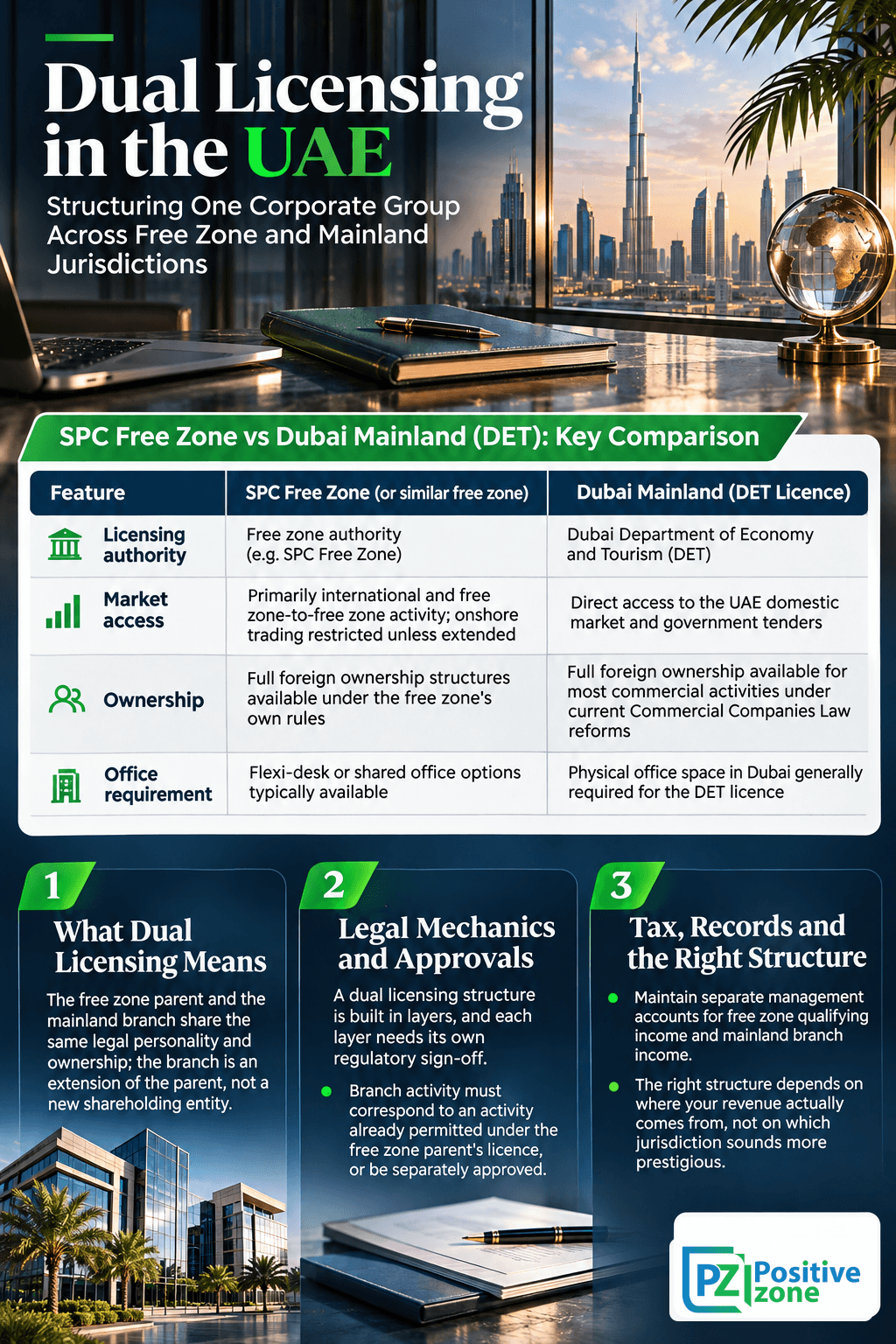
Dual licensing is a structuring approach that allows one corporate group to hold a free zone registration and a mainland trading licence at the same time, rather than operating as two disconnected companies with separate ownership. In practice, this almost always takes one of two forms: a free zone company extends its reach into mainland Dubai through a branch licence issued by the Dubai Department of Economy and Tourism (DET), or a mainland limited liability company establishes a branch inside a free zone to benefit from that zone's operating environment for a specific activity. The free zone parent and the mainland branch share the same legal personality and ownership; the branch is an extension of the parent, not a new shareholding entity.
We raise this distinction early because many founders search for dual licensing expecting to incorporate two independent companies that happen to share a brand. That is a different, and more expensive, structure involving two full company formations, two sets of statutory filings and, in most cases, two separate tax registrations. A true dual licence arrangement is narrower: it is a mechanism for one underlying business to be visible and compliant in both the free zone and the onshore market, under conditions set by the relevant free zone authority and DET.
The appeal is straightforward. A free zone company gives founders a lower-cost operating base, simplified share capital rules, and in many cases full access to international and group-level activity. A mainland DET licence gives the same group direct access to the UAE domestic market, eligibility for government and semi-government tenders, and the ability to lease commercial premises anywhere in Dubai without the restrictions that can apply to a free zone-only entity trading onshore.
- Free zone parent + DET branch licence: the most common dual licensing route for companies already registered in a free zone such as SPC Free Zone, IFZA, Meydan, RAKEZ, SHAMS or AFZA.
- Mainland parent + free zone branch: used where the core trading entity is a mainland LLC but a specific activity benefits from a free zone's facilities, customs treatment or cost base.
- Both routes preserve one beneficial ownership structure; they do not create two separately owned companies.
SPC Free Zone and Mainland DET Licensing Compared
SPC Free Zone, based in Sharjah, is one of the destinations we work with for founders who want a cost-efficient free zone base with broad activity lists and straightforward licence issuance. Mainland licensing in Dubai, by contrast, is administered by DET and is the route required for any business that wants to trade directly with customers located in the UAE domestic market without the restrictions that typically apply to free zone companies operating outside their own zone.
Neither option is inherently superior. They answer different commercial questions. A free zone licence answers the question of cost efficiency, simplified governance and international trading flexibility. A mainland licence answers the question of market access, office location flexibility and tender eligibility. Dual licensing exists precisely because many founders need both answers at once, rather than being forced to choose.
The table below sets out the practical differences founders ask us about most often when comparing an SPC Free Zone registration against a standalone Dubai mainland DET licence.
| Feature | SPC Free Zone (or similar free zone) | Dubai Mainland (DET Licence) |
|---|---|---|
| Licensing authority | Free zone authority (e.g. SPC Free Zone) | Dubai Department of Economy and Tourism (DET) |
| Market access | Primarily international and free zone-to-free zone activity; onshore trading restricted unless extended | Direct access to the UAE domestic market and government tenders |
| Ownership | Full foreign ownership structures available under the free zone's own rules | Full foreign ownership available for most commercial activities under current Commercial Companies Law reforms |
| Office requirement | Flexi-desk or shared office options typically available | Physical office space in Dubai generally required for the DET licence |
| Typical use case | Holding structures, international trade, consultancy, e-commerce, group cost centre | Retail, professional services serving UAE clients, construction-adjacent trading (excluding manpower supply), tendering for local contracts |
| Dual licensing role | Parent entity or branch recipient | Branch licence extension or standalone mainland entity |
The Legal Mechanics: Branch Licences, Approvals and DET Recognition
A dual licensing structure is built in layers, and each layer needs its own regulatory sign-off. The first layer is the free zone registration itself: incorporation of the company, issuance of its free zone trade licence, and confirmation of the activity codes the company is permitted to carry out. The second layer, where applicable, is the DET branch approval, which recognises the free zone entity as the parent of a mainland branch and authorises that branch to carry out a defined activity from a mainland address.
DET will generally require the branch activity to correspond to, or be compatible with, the activity already licensed at the free zone level. This matters in practice: a free zone company licensed for general trading cannot simply attach a branch for an unrelated regulated activity, such as healthcare or education, without separate approval from the sector regulator concerned, for example the Dubai Health Authority or the Knowledge and Human Development Authority. Dual licensing extends a company's geographic reach; it does not bypass activity-specific regulatory approval.
A further point of legal mechanics concerns liability and governance. Because the mainland branch is an extension of the free zone parent rather than a separately incorporated subsidiary, the parent company carries the legal and financial responsibility for the branch's activities. This has implications for contract signing authority, local service agent arrangements where relevant, and how banks and government departments view the group's overall exposure. We recommend reviewing the branch's scope of authority and signatory structure carefully before the branch licence is finalised, rather than treating it as an administrative formality.
- Branch activity must correspond to an activity already permitted under the free zone parent's licence, or be separately approved.
- Sector-specific regulators (health, education, financial services, legal practice) sit outside DET's general commercial licensing and require their own clearance regardless of the dual licensing route chosen.
- The free zone parent bears legal responsibility for obligations entered into by the mainland branch, so governance and signatory authority should be documented clearly from the outset.
- Lease documentation for the mainland branch's physical office is typically a precondition for DET branch approval.
Corporate Tax and Record-Keeping Considerations for Dual-Licensed Groups
The UAE's federal corporate tax regime applies to businesses operating through both free zone and mainland structures, though free zone entities that meet the conditions of a Qualifying Free Zone Person may benefit from preferential treatment on their qualifying income specifically. Income generated through a mainland branch attached to a free zone parent is generally treated differently from the parent's qualifying free zone income, because mainland-sourced trading activity typically falls outside the scope of free zone tax incentives.
This is the area where we see the most structuring mistakes. Founders set up a dual licensing arrangement for commercial reasons, start invoicing mainland customers through the branch, and only later discover that their bookkeeping does not cleanly separate free zone income from mainland branch income. Once revenue streams are mixed in a single set of accounts, it becomes far harder to demonstrate to the Federal Tax Authority which income qualifies for free zone treatment and which does not, and the group can lose the benefit of qualifying status altogether for the period in question.
Corporate tax rates, the qualifying income thresholds, and the specific conditions attached to Qualifying Free Zone Person status are set by federal legislation and Cabinet Decisions that are periodically updated. Rather than quoting a fixed rate or threshold here that may no longer reflect the current position, we recommend treating corporate tax registration and classification as a dedicated advisory exercise at the point a dual licensing structure is being designed, not after it has already gone live. Our Corporate Tax Registration & Filing Advisory service is built around exactly this scenario: confirming registration obligations for both the free zone parent and the mainland branch, and setting up a chart of accounts that keeps the two income streams distinguishable from day one.
Economic substance and transfer pricing documentation also deserve attention. Where the free zone parent and the mainland branch transact with each other, or with related group entities, the pricing and allocation of costs between them should be documented on an arm's length basis. This is standard practice for any group with intercompany dealings, and it becomes more important, not less, once a single legal entity is operating under two licences in two different regulatory environments.
- Maintain separate management accounts for free zone qualifying income and mainland branch income, even though both ultimately belong to one legal entity.
- Register for corporate tax at the group level and confirm with a tax advisor whether branch income disqualifies any portion of the parent's qualifying free zone status for the relevant tax period.
- Document intercompany pricing between the free zone parent and the mainland branch on an arm's length basis.
- Review VAT registration obligations separately, since VAT grouping and corporate tax grouping follow different rules.
Choosing the Right Structure for Your Business Model
The right dual licensing structure depends on where your revenue actually comes from, not on which jurisdiction sounds more prestigious. Founders whose customers are overseas, or who are building a holding structure for intellectual property, international consultancy or digital products, often find that a free zone entity alone is sufficient, with a mainland branch added only once genuine UAE domestic demand materialises. Founders whose business model depends on serving UAE-based retail customers, bidding for government contracts, or operating from a specific mainland commercial address from day one should generally start with the mainland licence and consider a free zone branch only for a defined supporting function.
We also ask founders to think about visa allocation and office footprint before finalising a structure. Free zone packages typically allocate visa quotas based on the office or desk type selected, while mainland companies allocate visas based on the physical office space leased. A dual licensing structure effectively gives a group two visa allocation pools, which can be an advantage for a growing team, but it also means two sets of Establishment Card and labour file obligations to maintain.
The table below summarises how we typically advise founders to approach the decision, based on the commercial scenario described to us.
| Business Scenario | Recommended Starting Structure | Why |
|---|---|---|
| International consultancy, no UAE walk-in clients | Free zone company only (e.g. SPC Free Zone) | Lower-cost base, full activity flexibility, mainland branch unnecessary until local demand exists |
| E-commerce brand selling to UAE and GCC consumers | Free zone parent with mainland DET branch for local fulfilment | Combines free zone cost efficiency with mainland retail and logistics access |
| Professional services firm targeting UAE government tenders | Mainland DET licence as the primary entity | Tender eligibility generally requires a mainland licence and, in many cases, a physical office |
| Group holding structure with multiple trading subsidiaries | Free zone holding company, with mainland or free zone branches/subsidiaries beneath it | Keeps IP and shareholding centralised while allowing operating units to be licensed where they trade |
| Import-export trading house | Mainland LLC with a free zone branch for customs and logistics efficiencies | Mainland licence supports direct domestic distribution; free zone branch can support bonded warehousing and international trade documentation |
How We Structure Dual-Licensed Groups at Positive Zone
We approach a dual licensing engagement as a single structuring exercise, not two unrelated transactions. The first stage is an activity and jurisdiction assessment: we review the commercial activity you intend to carry out, confirm which free zone and mainland activity codes correspond to it, and flag any sector-specific approvals that will sit outside the standard DET process. This stage determines whether a dual licensing route is actually available for your activity, or whether a standalone mainland or free zone entity is the more suitable starting point.
Once the structure is confirmed, we handle the formation of the free zone entity, whether that is SPC Free Zone, IFZA, Meydan, RAKEZ, SHAMS or AFZA, and we coordinate the subsequent DET mainland branch licensing where that route has been selected. Throughout this process we work directly with you on the documentation DET and the relevant free zone authority require, including lease agreements, board resolutions authorising the branch, and the activity descriptions that need to match across both licences.
Beyond formation, we support the group with the practical steps that determine whether a dual licensing structure actually functions day to day: corporate bank account opening and KYC advisory for the group's banking relationship, corporate tax registration and filing advisory to keep the free zone and mainland income streams correctly classified, and accounting and bookkeeping services to maintain the segregated financial records that the Federal Tax Authority and your bank will expect to see. Where the founders or key employees intend to relocate to the UAE, we also advise on UAE Golden Visa eligibility discussions as part of the same engagement, since visa planning is frequently tied to the entity structure chosen.
- Activity and jurisdiction assessment before any formation step is taken
- Free Zone Company Setup across SPC Free Zone, IFZA, Meydan, RAKEZ, SHAMS and AFZA
- Dubai Mainland LLC Formation & DET Licensing, including branch licence applications for existing free zone companies
- Corporate Bank Account Opening & KYC Advisory for the combined group structure
- Corporate Tax Registration & Filing Advisory to classify free zone and mainland income correctly
- Accounting & Bookkeeping Services to maintain segregated, audit-ready financial records
Article FAQs8 questions
Questions and answers
Dual licensing allows one corporate group, usually a single legal entity, to hold both a free zone registration and a mainland DET licence, most commonly through a free zone parent company extending operations via a DET branch licence. This differs from incorporating two separate companies, which would involve two distinct shareholding structures, two full sets of incorporation documents and, in most cases, two separate tax registrations as independent entities rather than one branch structure.