What a UAE Holding Company Actually Does
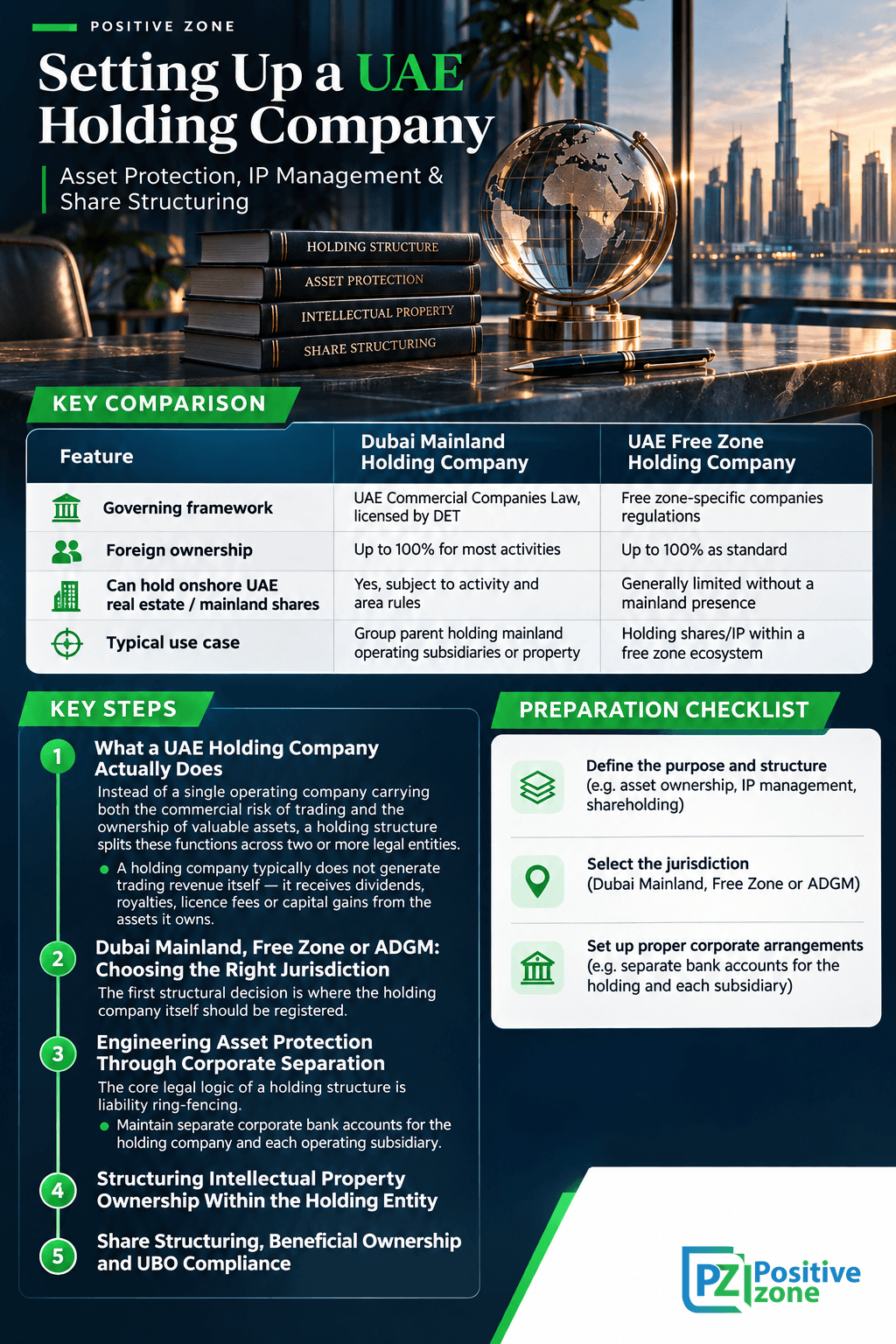
A holding company is a corporate vehicle whose principal function is to own assets — typically shares in other companies, intellectual property, real estate title or investment capital — rather than to trade directly with customers. Instead of a single operating company carrying both the commercial risk of trading and the ownership of valuable assets, a holding structure splits these functions across two or more legal entities. The holding entity sits above the structure, while one or more operating subsidiaries conduct the day-to-day business.
For foreign investors establishing a presence in the UAE, this separation has become a central planning tool. Dubai and the wider UAE allow 100% foreign ownership across most mainland activities following the Commercial Companies Law reforms, together with a well-developed free zone network and the common law-based Abu Dhabi Global Market (ADGM). Each of these environments can host a holding entity, but the legal character, permitted activities and typical use case differ considerably.
Our Senior Advisory Team at Positive Zone regularly guides founders, family offices and group structuring advisers through the decision between a Dubai mainland holding entity, a free zone holding company and an offshore vehicle. This guide sets out the practical distinctions, the asset protection logic behind holding structures, how intellectual property is typically positioned within them, and the share structuring and compliance obligations that follow.
- A holding company typically does not generate trading revenue itself — it receives dividends, royalties, licence fees or capital gains from the assets it owns.
- Operating subsidiaries carry the commercial risk of contracts, employment and customer liability, while the holding company's assets remain legally distinct.
- Holding structures are used for succession planning, investor-ready cap tables, intellectual property centralisation and multi-jurisdictional group organisation.
Dubai Mainland, Free Zone or ADGM: Choosing the Right Jurisdiction
The first structural decision is where the holding company itself should be registered. The UAE offers three broad categories relevant to holding structures: a mainland company licensed through the Dubai Department of Economy and Tourism (DET), a free zone company registered with one of the UAE's specialised economic zones, and an ADGM entity operating under Abu Dhabi's English common law-based regulatory framework. A fourth option — a pure offshore company — is used specifically where the entity will never trade physically within the UAE.
A Dubai mainland holding company is generally preferred where the structure needs to hold shares in other mainland companies, hold UAE real estate directly, or where the group anticipates needing to contract with UAE government entities or onshore clients at a later stage. Mainland entities fall under the UAE Commercial Companies Law and are licensed and regulated by DET.
A free zone holding company is typically used where the group's subsidiaries and assets sit within the same or complementary free zone ecosystems, or where the investor values the administrative simplicity of a single free zone regulator. Free zones named in our own service scope include SHAMS, SPC, RAKEZ, Meydan, IFZA and AFZA, each with its own registration authority and fee schedule.
ADGM is a financial free zone in Abu Dhabi operating its own companies regulations, closely modelled on English common law. It is widely referenced internationally as a jurisdiction for Special Purpose Vehicles (SPVs) and holding structures, particularly where investors want contractual certainty under a common law framework or are structuring alongside investment funds. Because ADGM's registration requirements, share capital conventions and fee structure are set and revised by the ADGM Registration Authority independently of Dubai's free zones, we recommend confirming the current framework directly with ADGM or through specialist corporate counsel before assuming any specific requirement applies to your structure.
| Feature | Dubai Mainland Holding Company | UAE Free Zone Holding Company | ADGM Holding / SPV Structure |
|---|---|---|---|
| Governing framework | UAE Commercial Companies Law, licensed by DET | Free zone-specific companies regulations | ADGM Companies Regulations, English common law basis |
| Foreign ownership | Up to 100% for most activities | Up to 100% as standard | Up to 100% as standard |
| Can hold onshore UAE real estate / mainland shares | Yes, subject to activity and area rules | Generally limited without a mainland presence | Generally limited without a mainland presence |
| Typical use case | Group parent holding mainland operating subsidiaries or property | Holding shares/IP within a free zone ecosystem | Investment holding, SPVs, fund-related structures |
| Governing law for contracts | UAE civil law system | Free zone civil law framework (zone-dependent) | English common law principles as adopted by ADGM |
| Physical office requirement | Generally required under DET rules | Varies by free zone package | Confirm current ADGM requirement directly |
Engineering Asset Protection Through Corporate Separation
The core legal logic of a holding structure is liability ring-fencing. Under the UAE's limited liability framework, each properly constituted company is a separate legal person. In principle, the creditors of an operating subsidiary cannot pursue the assets of its parent holding company simply because the two are related, provided the holding company has not given a personal guarantee, has not commingled funds, and has respected corporate formalities.
In practice, this means the valuable assets of a group — intellectual property, cash reserves, real estate title, equity stakes — should sit in the holding company, while the subsidiary exposed to supplier contracts, employment relationships and customer claims operates with only the capital and assets it needs to function. If the operating subsidiary later faces a dispute, enforcement action, or insolvency, the assets held one level up remain legally outside that subsidiary's estate.
Preserving this separation requires discipline rather than paperwork alone. Courts and regulators look at whether the entities were genuinely operated as separate businesses — separate bank accounts, arm's length intercompany agreements, accurate and timely bookkeeping, and board decisions taken at the correct corporate level. Where a holding company and its subsidiary share one bank account, lack documented intercompany loan or licence agreements, or fail to maintain statutory records, the corporate veil protecting the holding company becomes considerably more vulnerable to challenge.
This is one of the reasons we pair holding company formation with ongoing accounting and bookkeeping support. Clean, auditable financial records across each entity in the group are not a compliance afterthought — they are part of the asset protection architecture itself.
- Maintain separate corporate bank accounts for the holding company and each operating subsidiary.
- Document intercompany loans, royalty payments and management fees through written agreements reflecting arm's length terms.
- Keep board resolutions and shareholder decisions at the correct corporate level — do not let one entity's management silently control another's assets without documentation.
- Avoid personal guarantees on subsidiary-level financing wherever possible, as these reintroduce the personal liability a holding structure is designed to remove.
Structuring Intellectual Property Ownership Within the Holding Entity
A common and effective use of a UAE holding company is to act as the owner of the group's intellectual property — trademarks, patents, proprietary software, brand licences and domain portfolios — rather than leaving these assets registered in the name of an operating company exposed to trading risk.
Under this model, the holding entity (or a dedicated IP-holding subsidiary beneath it) owns the registered intellectual property outright. Each operating subsidiary, whether in the UAE or overseas, is then granted a licence to use that IP in exchange for a royalty or licence fee, paid under a documented intercompany agreement. This structure centralises the group's most valuable intangible assets in a single, more insulated entity, and creates a clear, auditable royalty stream that supports both internal governance and future investor due diligence.
Two compliance points deserve particular attention. First, intercompany royalty and licensing arrangements fall within scope of transfer pricing principles under the UAE Corporate Tax regime introduced by Federal Decree-Law No. 47 of 2022, meaning royalty rates and terms should reflect what unrelated parties would agree to on an arm's length basis, supported by appropriate documentation. Second, where IP or associated assignment agreements originate from outside the UAE, foreign documents frequently require legalisation before UAE authorities will recognise them — a process our document attestation service, covering MEA and MOFA attestation, is designed to support.
Trademark and patent registration itself sits with the relevant UAE federal authority and is a separate process from company formation. We recommend treating IP registration, IP assignment into the holding entity, and the licensing framework between holding company and operating subsidiaries as three distinct legal steps, each requiring its own documentation trail.
Share Structuring, Beneficial Ownership and UBO Compliance
Once the jurisdiction is chosen, the next design decision is the share structure itself — how shares in the holding company, and in turn the shares the holding company owns in its subsidiaries, are allocated, classed and recorded. A typical multi-tier structure places the Ultimate Beneficial Owner (the individual investor or family) at the top, holding shares directly in the UAE holding company, which in turn owns the operating subsidiaries and any dedicated IP-holding entity beneath it.
Share classes can be used within this structure to separate economic rights from control — for example, founders retaining voting ordinary shares while external investors hold non-voting or preference shares with defined dividend rights. This is a standard tool for investor-ready cap tables and succession planning, but the specific mechanics (permitted share classes, minimum share capital, transfer restrictions) vary by jurisdiction and should be confirmed against the chosen free zone's, mainland authority's or ADGM's current companies regulations before the structure is finalised.
A critical and frequently underestimated compliance layer is Beneficial Ownership (UBO) regulation. Under Cabinet Decision No. 58 of 2020 and subsequent amendments, most UAE mainland and free zone companies are required to identify, record and file information on their Real Beneficial Owners with the relevant licensing authority, and to keep this register current. Nominee shareholder arrangements, informal trust arrangements or undisclosed beneficial interests are increasingly scrutinised, and a holding structure built on opaque ownership is both a compliance risk and a practical obstacle when opening corporate bank accounts, since banks conduct their own KYC review of the full ownership chain during account opening.
A clean, well-documented share register also matters beyond day-to-day compliance. Clear evidence of shareholding is frequently requested during investor-category visa applications, including the UAE's 10-Year Investor Golden Visa route. We assist clients with Golden Visa processing as part of a holding company engagement, but eligibility criteria are set by the relevant federal authority and should be confirmed for each applicant's circumstances rather than assumed from general guidance.
| Structural Layer | Typical Role | Key Compliance Consideration |
|---|---|---|
| Ultimate Beneficial Owner (individual/family) | Holds shares directly in the UAE holding company | Must be identified and recorded in the UBO register |
| UAE Holding Company | Owns shares in operating subsidiaries and/or IP entity | Jurisdiction choice (mainland, free zone or ADGM) fixes applicable companies law |
| IP-Holding Subsidiary (optional) | Owns registered trademarks, patents, software | Licence agreements with operating subsidiaries must be arm's length and documented |
| Operating Subsidiary / Subsidiaries | Conducts trading activity, employs staff, contracts with customers | Carries commercial and employment liability; should hold only operational assets |
Corporate Tax Residency and Compliance Obligations for Holding Companies
The UAE Corporate Tax regime, introduced under Federal Decree-Law No. 47 of 2022, applies broadly across mainland and free zone entities, and holding companies are not automatically exempt simply because their income consists of dividends or capital gains rather than trading revenue. In general, taxable income above the statutory threshold is taxed at the headline 9% rate, while free zone entities meeting the conditions of a Qualifying Free Zone Person may continue to benefit from a 0% rate on Qualifying Income, subject to meeting substance and activity conditions set by the Ministry of Finance and Federal Tax Authority.
A practical point we emphasise with every holding structure client is that Corporate Tax registration is generally expected regardless of current profitability, and the obligation to register, maintain records and file returns applies to the holding entity in its own right, separately from any operating subsidiary in the group. Groups structuring intercompany royalty or management fee flows between a holding company and its subsidiaries should also expect these arrangements to be reviewed under the UAE's transfer pricing rules, which are aligned with OECD principles and require contemporaneous documentation for related-party transactions above the relevant thresholds.
Economic substance expectations for holding and SPV-type entities are an area that continues to evolve, and we recommend confirming the current substance requirements applicable to your specific entity type and jurisdiction rather than relying on earlier guidance, since these requirements are periodically revised by the relevant federal and free zone authorities.
Finally, many investors are drawn to UAE holding structures partly because of the UAE's extensive double tax treaty network. Access to treaty benefits, however, typically depends on the holding company obtaining a Tax Residency Certificate and demonstrating adequate substance in the UAE — it is not an automatic consequence of incorporation. Our corporate tax registration and filing advisory service is designed to help clients navigate registration, documentation and ongoing filing obligations as these rules apply to their specific holding structure.
How Positive Zone Supports Your UAE Holding Company Formation
Building a holding structure correctly from the outset is considerably more efficient than restructuring an existing company later, particularly once intellectual property has been registered, bank accounts opened, or shareholder agreements signed under an unsuitable framework. Our Senior Advisory Team works with founders, family offices and group structuring advisers to select the appropriate jurisdiction — Dubai mainland, a relevant UAE free zone, or an offshore vehicle — based on what the holding company will actually own and how it will interact with subsidiaries.
Positive Zone's service scope covers mainland LLC formation and DET licensing, free zone company setup, and offshore company setup, together with corporate bank account assistance and KYC advisory to help prepare the documentation banks require when reviewing a multi-tier ownership structure. We also support UAE 10-Year Investor Golden Visa processing, Corporate Tax registration and filing advisory, and ongoing accounting and bookkeeping services, so that the holding company and its subsidiaries remain compliant as the group grows.
Where a structure involves foreign-issued documents — an overseas IP assignment, a foreign shareholder's incorporation certificate, or a power of attorney — our document attestation service for MEA and MOFA legalisation helps ensure these documents are recognised by UAE authorities and banks.
Contact Positive Zone to discuss your holding company requirements and request a tailored quotation specific to your intended jurisdiction, asset base and group structure.
Article FAQs1 question
Questions and answers
An operating company trades directly with customers, employs staff and carries the commercial risk of day-to-day business. A holding company's principal role is to own assets — typically shares in subsidiaries, intellectual property or real estate — and does not usually conduct trading activity itself. Separating these functions across two entities is the basis of most asset protection structures.