What a Dubai Industrial License Actually Covers
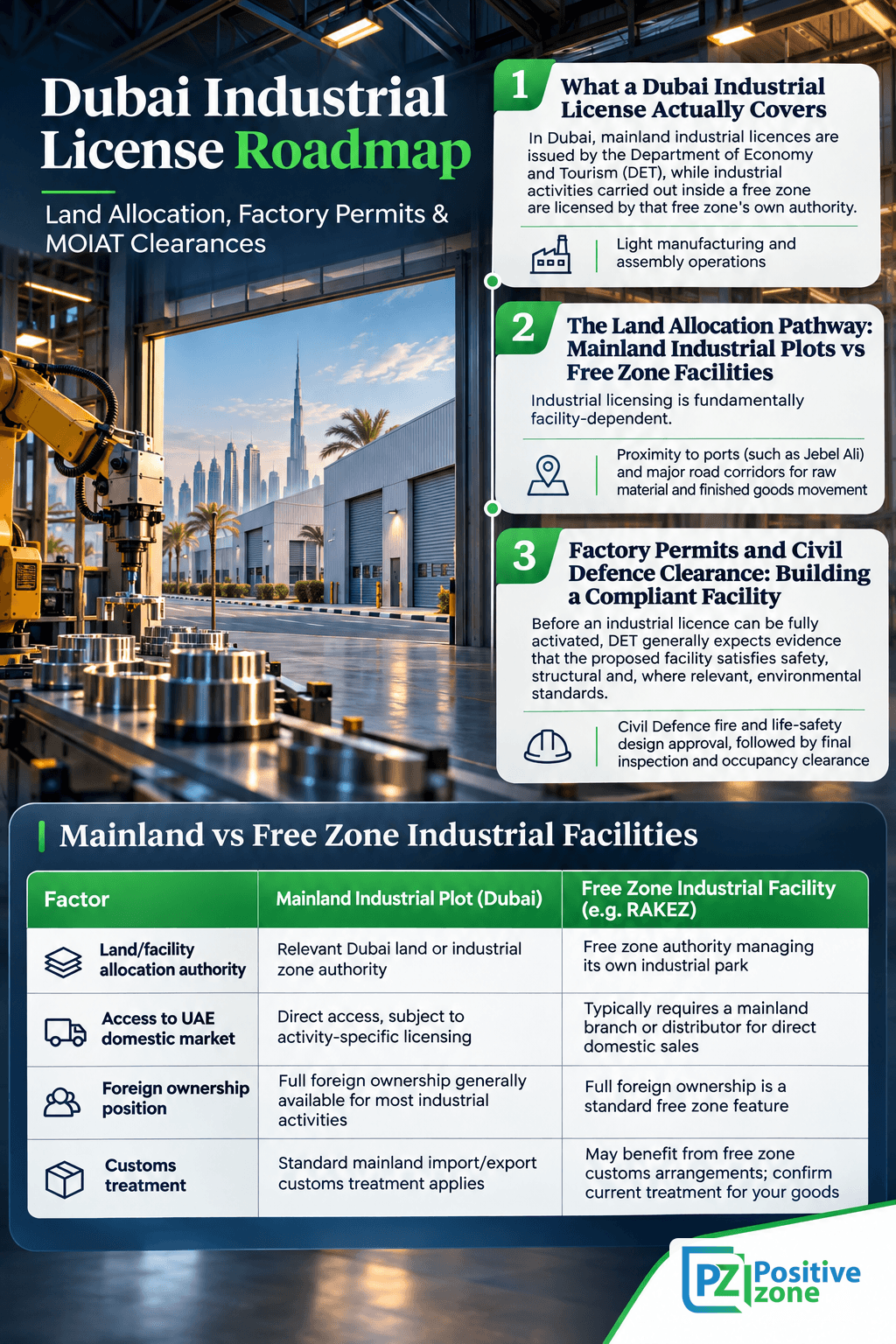
An industrial licence authorises a company to manufacture, process, assemble, package or extract goods for commercial purposes, as distinct from a commercial licence (trading and distribution) or a professional licence (services and consultancy). In Dubai, mainland industrial licences are issued by the Department of Economy and Tourism (DET), while industrial activities carried out inside a free zone are licensed by that free zone's own authority. In both cases, the activity you select must be matched to the correct classification code before any land, facility or regulatory approval process can begin.
What distinguishes industrial licensing from most other licence categories is the dual regulatory structure sitting behind it. DET (or the relevant free zone authority) governs the company's commercial registration, trade name and legal structure at the emirate level. Running alongside this, the Ministry of Industry and Advanced Technology (MOIAT) exercises a federal mandate to regulate and develop the UAE's wider industrial base. In practice, this means an industrial establishment in Dubai is rarely 'done' once the DET certificate is issued; a parallel federal registration and, depending on the product, additional conformity clearances are generally also required.
Because classification frameworks and risk-based categorisations used by regulators are periodically revised, we treat precise document lists, fee schedules and processing timeframes as information that must be confirmed at the time of your specific application, rather than figures that can be safely reused from older guidance. Our role at this stage is to help you identify the correct activity code and map out which authorities will need to be engaged, before you commit capital to a facility or land plot.
- Light manufacturing and assembly operations
- Food and beverage processing and packaging
- Textiles, garments and leather goods production
- Metal fabrication, machinery and equipment manufacturing
- Chemicals, plastics and rubber processing
- Electronics, components and technical equipment assembly
The Land Allocation Pathway: Mainland Industrial Plots vs Free Zone Facilities
Industrial licensing is fundamentally facility-dependent. Unlike an office-based commercial or professional licence, an industrial licence cannot usually be activated against a shared desk or virtual address. The authority needs evidence of a physical manufacturing floor, storage capacity and, often, loading or logistics access that is appropriate to the declared activity. This makes the land or facility allocation decision one of the earliest and most consequential steps in the entire roadmap, not an afterthought once the licence is issued.
On the mainland route, an investor typically identifies a suitable designated industrial zone in Dubai, then applies for the lease or allocation of a plot or built facility through the relevant land or zone authority. Once that lease is registered, it becomes the basis for the company's registered address with DET, and it is the facility against which Civil Defence, Municipality and, where applicable, environmental approvals will later be assessed.
An alternative pathway is to establish within a dedicated industrial free zone. Among the free zone destinations referenced in our service scope, RAKEZ (Ras Al Khaimah Economic Zone) maintains an industrial park offering land plots and pre-built warehouse facilities, which can allow company formation and facility allocation to be coordinated within a single free zone framework. This can simplify the practical sequencing of land and licence steps, although free zone companies generally need a mainland branch, distributor or equivalent arrangement to sell directly into the UAE domestic market, which should be factored into your commercial planning rather than assumed.
- Proximity to ports (such as Jebel Ali) and major road corridors for raw material and finished goods movement
- Available utility capacity, particularly power load and water supply suited to industrial equipment
- Zoning compliance for your specific activity, including any buffer or separation requirements from residential areas
- Labour accommodation proximity and compliance, where on-site or nearby housing is part of your operating model
- Whether a warehouse-style unit, open land plot or build-to-suit facility best matches your production process
- Room for future expansion if your production volumes are expected to scale
| Factor | Mainland Industrial Plot (Dubai) | Free Zone Industrial Facility (e.g. RAKEZ) |
|---|---|---|
| Land/facility allocation authority | Relevant Dubai land or industrial zone authority | Free zone authority managing its own industrial park |
| Access to UAE domestic market | Direct access, subject to activity-specific licensing | Typically requires a mainland branch or distributor for direct domestic sales |
| Foreign ownership position | Full foreign ownership generally available for most industrial activities | Full foreign ownership is a standard free zone feature |
| Customs treatment | Standard mainland import/export customs treatment applies | May benefit from free zone customs arrangements; confirm current treatment for your goods |
| Regulatory touchpoints | DET plus MOIAT and relevant Dubai municipal/civil defence bodies | Free zone authority plus MOIAT federal registration where applicable |
Factory Permits and Civil Defence Clearance: Building a Compliant Facility
Before an industrial licence can be fully activated, DET generally expects evidence that the proposed facility satisfies safety, structural and, where relevant, environmental standards. This evidence does not come from DET itself; it is issued by other authorities with jurisdiction over the building and its operations, principally Dubai Civil Defence and Dubai Municipality, with the Municipality's Environment Department becoming relevant where the activity involves emissions, effluent or hazardous materials.
Dubai Civil Defence typically reviews fire and life-safety arrangements twice: once at the design or fit-out stage, confirming that proposed extinguishers, alarms, sprinkler provisions and emergency exits meet applicable codes, and again after construction or fit-out is complete, through a final inspection leading to occupancy clearance. Dubai Municipality, in parallel, is generally responsible for confirming that the building itself complies with the approved structural plan before issuing a building completion or occupancy certificate.
Depending on the nature of the industrial activity, further approvals can apply. Activities generating industrial discharge, airborne emissions or hazardous waste commonly require an environmental no-objection certificate from the Municipality's Environment Department. Facilities with a substantial power requirement need a connection approval sized to industrial load from Dubai Electricity and Water Authority (DEWA). Where on-site labour accommodation is provided, additional compliance obligations apply through the Ministry of Human Resources and Emiratisation. Because the combination of approvals genuinely varies by activity, building type and zone, we treat the exact checklist as something to confirm for your specific facility rather than a fixed universal list.
- Civil Defence fire and life-safety design approval, followed by final inspection and occupancy clearance
- Dubai Municipality building completion certificate confirming structural compliance
- Environmental no-objection certificate where discharge, emissions or hazardous materials are involved
- DEWA connection approval sized to the facility's industrial power and water load
- Health and safety sign-off for installed machinery, where applicable to the activity
Article FAQs8 questions
Questions and answers
It authorises manufacturing, processing, assembling, packaging or extracting goods for commercial purposes. This is different from a commercial licence (trading and distribution) or a professional licence (services and consultancy).