Civil Company or LLC: Answering the Core Question First
Foreign consultants, doctors and architects relocating to Dubai are frequently told to simply pick a Limited Liability Company because it sounds safer, or a Civil Company because a competitor used one. Neither reason is sound. The correct structure is determined by how the Dubai Department of Economy and Tourism (DET) classifies the specific economic activity you intend to practise, and in many professional fields, by the requirements of a sector regulator such as the Dubai Health Authority or a relevant engineering body.
In broad terms, a Civil Company is the mainland vehicle historically reserved for individuals exercising a recognised profession, where the service delivered depends on personal qualification, skill and judgement rather than trading in goods or deploying capital. A Limited Liability Company, by contrast, is the standard commercial vehicle used for trading, industrial and many service activities where liability is intended to sit with the company's capital rather than with the individual owners personally.
Our Senior Advisory Team at Positive Zone works through DET's activity classification for each client before recommending a structure. This guide sets out the legal and practical distinctions so that consultants, doctors and architects can approach that classification exercise with realistic expectations, rather than discovering mid-application that their preferred structure is not available for their activity.
The Civil Company Structure: Built Around the Licensed Professional
A Civil Company in Dubai is a mainland licensing form designed for professionals whose work is based on personal expertise rather than trade or industrial capital. Typical activities include legal consultancy, medical and dental practice, engineering consultancy, architectural consultancy, accounting and auditing, and various forms of specialised technical or intellectual consultancy. The underlying principle is that the value delivered to the client is the professional's own skill, so the licence is tied closely to the qualifications of the named partners.
A distinguishing feature of the Civil Company model is the Local Service Agent arrangement that applies to many professional licences. The Local Service Agent is typically a UAE national or a company wholly owned by UAE nationals who is appointed to liaise with government departments on the licensee's behalf. Importantly, in the conventional professional licence structure, the Local Service Agent does not take an equity stake in the business and has no automatic entitlement to profits; the relationship is usually governed by a service agreement with a fixed fee. The exact terms, obligations and current requirements for any Local Service Agent arrangement should always be confirmed in the specific agreement signed for your licence, since practice can vary by activity and by emirate.
Because the Civil Company is built around the professional rather than around invested capital, ownership of the practice itself generally sits with the qualified partner or partners. This is one of the structure's most attractive features for solo consultants, specialist doctors and boutique architectural practices who want to retain full control over how the practice is run, who is hired, and how client relationships are managed.
The trade-off is that a Civil Company does not function as a limited liability shield in the way an LLC does. Partners in a Civil Company generally remain personally and professionally accountable for the standard of service delivered, which is consistent with how regulated professions are treated in most jurisdictions worldwide. This is an important planning point for doctors and architects in particular, who should maintain appropriate professional indemnity insurance regardless of which corporate structure they ultimately choose.
- Used for activities DET classifies as professional: legal, medical, engineering, architectural, accounting, and similar consultancy fields.
- Ownership generally rests with the qualified professional partner or partners rather than external investors.
- A Local Service Agent typically assists with government liaison under a service agreement, without taking equity or management control, though exact terms must be confirmed per agreement.
- Partners carry personal and professional accountability; the structure does not replace the need for sector-specific regulatory approval or professional indemnity cover.
The LLC Structure: Commercial Flexibility With Limited Liability
A Limited Liability Company is the most widely used mainland vehicle in the UAE for commercial, trading, industrial and many general service activities. Under the Commercial Companies Law framework, liability for the company's debts and obligations is generally limited to each shareholder's capital contribution, which is the principal reason LLCs are favoured by founders who want a clear separation between personal assets and business risk.
Ownership rules for LLCs have evolved significantly in recent years. Reforms to the UAE Commercial Companies Law opened the door to full foreign ownership for a wide range of commercial and industrial activities on DET's determined list, removing the historical requirement for a UAE national shareholder in many sectors. However, certain strategically sensitive activities may still carry additional conditions or require specific approvals. Because this list and its conditions are reviewed and updated by the authorities, we recommend confirming the current ownership position for your precise activity code directly with DET or through our Dubai Mainland Setup and DET Licensing service before finalising your shareholding structure.
For consultants whose work falls outside the strictly regulated professional categories, for example general management consultancy, business advisory services, marketing consultancy or technology consultancy that DET classifies as commercial rather than professional, an LLC is often the appropriate and more flexible vehicle. It allows for multiple shareholders, straightforward profit distribution according to shareholding, and a corporate structure that is generally easier to scale, bring in investors, or eventually sell as a going concern.
- Liability is generally limited to each shareholder's capital contribution in the company.
- Many commercial and industrial activities now permit full foreign ownership, subject to the activity-specific rules in force at the time of licensing.
- Suited to consultancy and service activities that DET classifies as commercial rather than strictly professional.
- Generally more straightforward to scale with multiple shareholders, external investment or eventual sale.
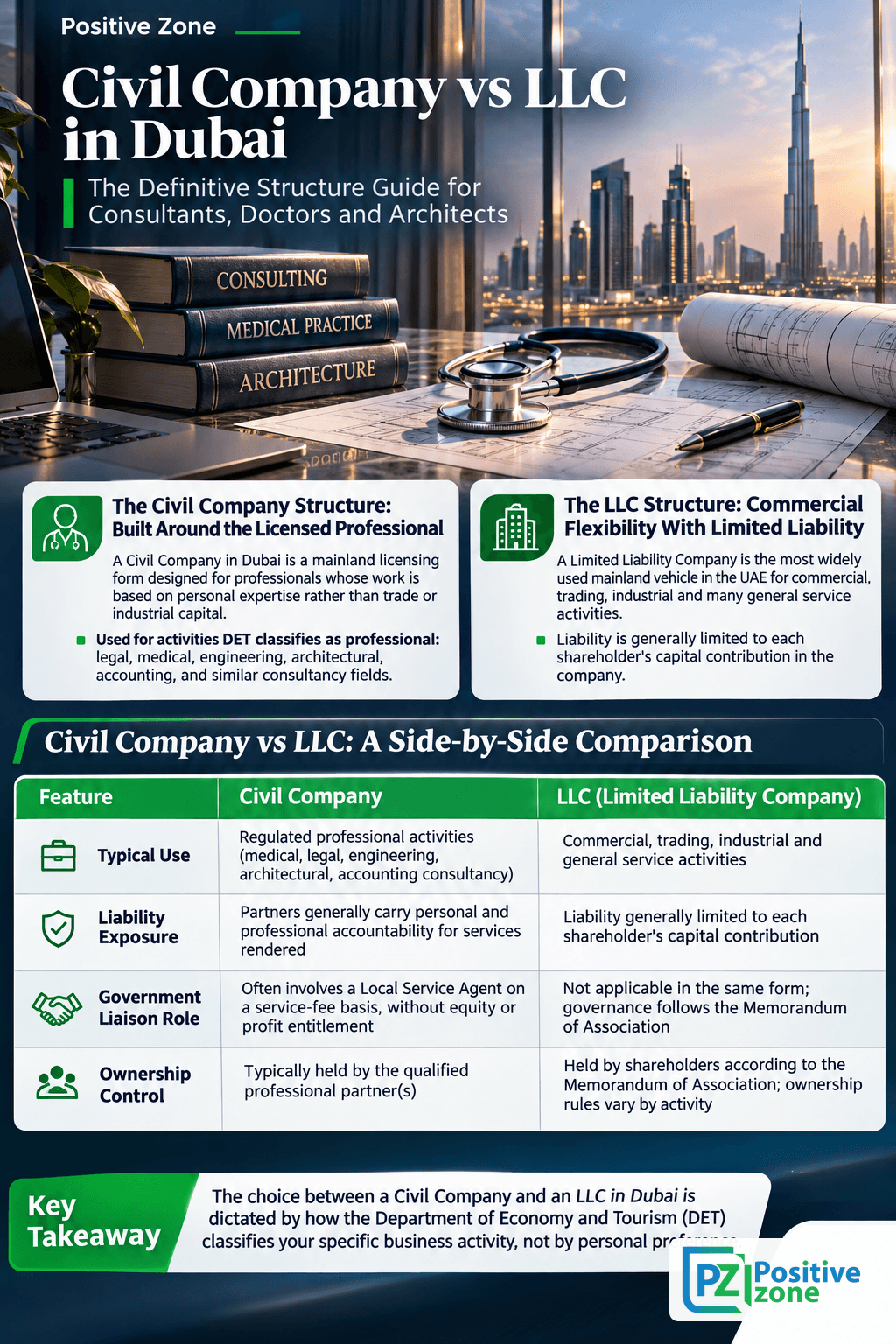
Civil Company vs LLC: A Side-by-Side Comparison
The table below summarises the principal distinctions our Senior Advisory Team reviews with clients during the structuring conversation. It is intended as an orientation tool; the precise position for any given activity should always be confirmed with DET and, where relevant, the applicable sector regulator before a final decision is made.
| Feature | Civil Company | LLC (Limited Liability Company) |
|---|---|---|
| Typical Use | Regulated professional activities (medical, legal, engineering, architectural, accounting consultancy) | Commercial, trading, industrial and general service activities |
| Liability Exposure | Partners generally carry personal and professional accountability for services rendered | Liability generally limited to each shareholder's capital contribution |
| Government Liaison Role | Often involves a Local Service Agent on a service-fee basis, without equity or profit entitlement | Not applicable in the same form; governance follows the Memorandum of Association |
| Ownership Control | Typically held by the qualified professional partner(s) | Held by shareholders according to the Memorandum of Association; ownership rules vary by activity |
| Professional Qualification Requirement | Partners usually require recognised professional qualifications relevant to the licensed activity | Not generally required unless the specific activity is professionally regulated |
| External Regulator Involvement | Frequently required (e.g. Dubai Health Authority for medical practice, engineering authorities for architectural consultancy) | Varies; required only where the commercial activity itself is separately regulated |
| Scalability for Investment | Less conventional for bringing in outside investors due to the personal nature of the licence | Generally more adaptable for additional shareholders or future investment |
| Corporate Tax Registration | Required in line with current Federal Tax Authority rules for the entity's taxable position | Required in line with current Federal Tax Authority rules for the entity's taxable position |
Matching the Structure to the Profession: Consultants, Doctors and Architects
Medical practitioners establishing a clinic, polyclinic or specialist practice in Dubai are typically required to register their licence as a Civil Company, in parallel with obtaining the clinical facility and practitioner approvals from the Dubai Health Authority. The Civil Company framework reflects the personal and professional nature of medical practice, where the treating doctor's qualification is central to the service delivered. Any doctor exploring an LLC route for a clinical practice should treat this as the exception requiring explicit confirmation from DET and the Dubai Health Authority, not the default assumption.
Architects and engineers offering design or engineering consultancy services are generally also directed toward the Civil Company structure, because DET classifies architectural and engineering consultancy as professional activities tied to the individual's recognised qualification. In addition to the DET trade licence, architectural and engineering practices usually need to register separately with the relevant engineering or municipal authority governing design approvals in the emirate. Firms that intend to combine design services with elements of trading, such as selling building materials or offering turnkey fit-out and construction management, should discuss this combination carefully with us, since mixed activities can sometimes require a different licensing approach or an additional licence.
Consultants occupy the most varied territory of the three professions discussed in this guide. Strategic, legal, tax and certain technical consultancy activities are frequently classified as professional and therefore channelled toward a Civil Company. General management consultancy, marketing consultancy, HR consultancy, IT consultancy and many business advisory activities, on the other hand, are often classified as commercial activities suitable for an LLC. The dividing line depends entirely on how DET has coded the specific consultancy activity at the time of application, which is precisely why we treat activity classification, not personal preference, as the starting point of every mainland engagement.
- Medical practice: typically Civil Company, combined with Dubai Health Authority facility and practitioner approvals.
- Architecture and engineering consultancy: typically Civil Company, combined with the relevant engineering or municipal authority registration.
- Strategic, legal, tax and specialised technical consultancy: frequently Civil Company depending on DET's classification.
- General management, marketing, HR and IT consultancy: often classified as commercial and suitable for an LLC, subject to confirmation.
Ownership, Liability and the Local Service Agent Relationship in Practice
A common misconception among newly arrived professionals is that the Local Service Agent in a Civil Company functions in the same way as the former equity sponsor once required for mainland LLCs. This is incorrect under the conventional professional licensing model: the Local Service Agent's role is administrative, centred on liaison with government departments, and is generally remunerated through a fixed contractual fee rather than a share of profits or ownership of the business. We always recommend that clients review the exact wording of their Local Service Agent agreement line by line, since obligations and renewal terms can differ between agents and between activities.
On the liability side, it is important for doctors, architects and licensed consultants to understand that neither structure removes professional accountability. An LLC's limited liability protection is designed primarily to ring-fence personal assets from the company's general commercial and financial obligations, such as supplier debts or lease liabilities. It does not, and is not intended to, shield a licensed professional from regulatory sanctions or negligence claims arising from substandard professional work. Civil Company partners are in a broadly similar position: the structure reflects the personal nature of the licence rather than providing a liability shield. For this reason, maintaining current professional indemnity insurance and complying with ongoing continuing professional development or registration requirements set by the relevant sector regulator remains essential regardless of corporate form.
Both Civil Companies and LLCs are also subject to UAE corporate tax registration and filing obligations under current Federal Tax Authority rules, in line with the entity's taxable income position. We encourage clients to build tax registration, bookkeeping and periodic filing into their launch plan from the outset rather than treating it as a later administrative task. Our Corporate Tax Registration and Filing Advisory service, together with our Accounting and Bookkeeping Services, are designed to help professionals keep their financial records audit-ready and their filings current once the licence is issued.
- Confirm the exact scope, fee basis and renewal terms of any Local Service Agent agreement before signing.
- Professional indemnity insurance and sector regulator compliance remain necessary regardless of whether you operate as a Civil Company or an LLC.
- Corporate tax registration and periodic filing apply to both structures under current Federal Tax Authority rules.
- Plan bookkeeping systems from the licensing stage to avoid compliance gaps once trading begins.
The Formation Journey: From Activity Classification to Licence Issuance
Once the appropriate structure has been identified, the practical formation journey follows a broadly consistent sequence for both Civil Companies and LLCs, though professional licences involve additional regulator touchpoints. Understanding this sequence helps professionals plan realistic timelines for their relocation and client onboarding.
We support consultants, doctors and architects through each of these milestones as part of our Dubai Mainland Setup and DET Licensing service, coordinating with the relevant sector regulators where a professional approval is required, and handling the administrative liaison work through our PRO Services so that founders can focus on their clinical practice, design work or client engagements rather than paperwork.
- Confirm the precise DET activity classification and whether a Civil Company or LLC applies to your intended services.
- Reserve a trade name consistent with DET's naming conventions for the chosen activity.
- For professional activities, obtain the relevant sector regulator's initial approval (for example, Dubai Health Authority for medical practice or the applicable engineering authority for architectural consultancy).
- Appoint a Local Service Agent where the professional licence structure requires one, and finalise the service agreement.
- Secure DET initial approval and prepare the Memorandum of Association or Civil Company contract as applicable.
- Arrange a compliant office lease, since mainland licences generally require a registered physical address.
- Submit the final documentation to DET and obtain the trade licence.
- Apply for establishment immigration cards and the relevant visas, including Golden Visa assessment where the applicant may qualify as a qualifying investor or specialised professional.
- Open a corporate bank account with the support of our Corporate Bank Account Opening and KYC Advisory service.
- Register for corporate tax with the Federal Tax Authority and establish an ongoing bookkeeping process.
Common Structuring Mistakes We Help Professionals Avoid
In our experience advising foreign professionals relocating to Dubai, most structuring problems arise not from a flawed business plan but from an assumption about legal form that turns out to be incompatible with the activity as DET classifies it. Addressing these issues before submission saves considerable time and cost.
Our Senior Advisory Team reviews each prospective activity against DET's current classification and the requirements of any applicable sector regulator before recommending a structure, so that the licence application submitted is the one that will actually be approved, rather than one that needs to be reworked midway through the process.
- Assuming an LLC is available for a professional activity that DET classifies as a Civil Company activity, discovered only at the application stage.
- Treating the Local Service Agent as a business partner with equity or management rights, when the conventional arrangement is a fee-based administrative role.
- Overlooking the parallel approval required from a sector regulator, such as the Dubai Health Authority for medical practice or an engineering authority for architectural work.
- Underestimating ongoing compliance obligations, including corporate tax registration, bookkeeping and periodic filing, once the licence is active.
- Failing to clarify whether mixed professional and commercial activities require more than one licence.
Article FAQs2 questions
Questions and answers
Civil Companies are generally structured around the qualified professional partner or partners, and ownership commonly rests with those individuals rather than external investors. The specific nationality and licensing requirements, including whether a Local Service Agent is required for your particular activity, should be confirmed with DET at the time of application, since requirements can vary by profession.